
How Venue-by-Venue Marketing Actually Works on a UK Theatre Tour
Marketing a UK theatre tour isn’t simply about promoting the tour nationally. Every venue has a different audience, ticket-sales pattern and local market. Here’s how venue-by-venue marketing actually works — and how touring productions can build campaigns around the performance of individual dates.
8–10 minute read
By Junior Goude | Encore Essentials
Quick Answer
Venue-by-venue theatre tour marketing combines an overall production campaign with individual campaigns for each tour date. Marketing is adapted around the venue, location, audience, ticket-sales performance and available marketing channels, while maintaining consistent branding across the tour. This allows activity to respond to individual venue performance rather than treating every date equally.
A UK Theatre Tour Is Not One Market
A touring production might visit 10, 20, 30 or more venues across the UK.
The production remains the same.
The audience doesn’t.
A show arriving in Nottingham is entering a different market from the same production appearing in Manchester, Glasgow, Birmingham or London.
Each venue may have a different audience database, social media following, capacity, ticket price, local reputation and level of marketing support.
Some venues may begin selling strongly immediately.
Others may require considerably more work.
This is why an effective theatre tour marketing strategy shouldn’t simply promote “the tour.”
It should promote the individual performances within the tour while maintaining a strong, recognisable identity around the overall production.
That is where venue-by-venue marketing begins.
What Is Venue-by-Venue Theatre Marketing?
Venue-by-venue marketing is the process of treating each performance on a UK theatre tour as its own local marketing opportunity while keeping every date connected to the wider tour campaign.
Instead of simply running one advert saying:
UK TOUR — TICKETS ON SALE NOW
and expecting it to perform equally across the country, the campaign can be divided into individual markets.
A customer in Nottingham might see creative promoting the Nottingham date.
Someone in Manchester sees Manchester.
Someone in Birmingham sees Birmingham.
Each campaign can have its own:
Audience targeting
Advertising budget
Creative
Venue information
Ticket link
Geographic targeting
Performance data
The production remains consistent.
The way individual dates are marketed can change.
One Tour. Multiple Local Markets.
Nottingham
Local Audience
Venue Support
Ticket Sales
Advertising
Manchester
Local Audience
Venue Support
Ticket Sales
Advertising
Birmingham
Local Audience
Venue Support
Ticket Sales
Advertising
The show stays consistent. The strategy around each venue evolves.
Why Doesn't One National Campaign Work for Every Theatre?
A production may be extremely well established in one region while having relatively little awareness in another.
One theatre might have an excellent internal marketing department, a substantial email database and a highly engaged social audience.
Another might provide little more than a listing on its website.
Ticket capacities change.
Ticket prices change.
Local competition changes.
Audience demographics change.
Even the day of the week can influence the performance of a date.
That means two performances of exactly the same production can produce completely different ticket-sales patterns.
Venue-by-venue marketing allows the campaign to recognise those differences rather than assuming that every market behaves in the same way.
Start With the Tour as a Whole
Venue-specific marketing does not mean losing the overall identity of the production.
Before individual campaigns begin, the tour needs a strong and consistent foundation.
That includes the production’s:
- Artwork
- Branding
- Photograhy
- Live Videos
- Showreel
- Website
- Social Media Presence
- Messaging
- Overall Positioning
Someone seeing an advert in Newcastle should recognise the same production when they later encounter it on Instagram, Google or the show’s website.
Consistency builds familiarity.
But consistency does not mean every advert has to be identical.
The tour provides the brand.
The venue campaign provides the local context.
Build a Marketing Plan Around Every Tour Date
Every venue should be monitored individually.
You should be able to see the venue, location, performance date, capacity, ticket link, current sales, percentage sold, advertising activity and planned marketing support.
Instead of simply saying:
“The tour is around 60% sold.”
you start to see the real picture.
Example: Five Venues on the Same Tour
|
Venue
|
Capacity Sold
|
Marketing Priority
|
|---|---|---|
|
Venue A
|
91%
|
Low
|
|
Venue B
|
73%
|
Monitor
|
|
Venue C
|
34%
|
High
|
|
Venue D
|
68%
|
Monitor
|
|
Venue E
|
27%
|
High
|
The important point
Don’t spend the same amount of time and money on every venue simply because they’re part of the same tour.
Venue C and Venue E clearly require more attention than Venue A.
Once the tour is viewed this way, marketing decisions become considerably easier.
Use Ticket-Sales Data to Decide Where Marketing Is Needed
Imagine two theatres both have a capacity of 1,000.
One has sold 250 tickets with six weeks remaining.
The other has already sold 800.
Should they receive the same advertising budget?
Probably not.
The stronger venue may already have enough momentum that additional advertising produces diminishing returns.
The weaker date requires investigation.
But the answer isn’t automatically:
Spend more money.
First ask why the venue isn’t moving.
Is awareness low?
Has the venue carried out its planned marketing?
Are people clicking advertisements but not buying?
Is the creative communicating the experience properly?
Is the ticketing journey difficult?
Is the ticket price creating friction?
Is another major event taking place locally?
Is the production simply reaching the wrong audience?
Good theatre marketing doesn’t just react.
It diagnoses.
Some Dates Selling. Others Struggling?
Encore Essentials helps touring productions build marketing campaigns around the real performance of individual venues.
Instead of treating every tour date the same, we can combine ticket-sales information with advertising, creative, website data and venue activity to identify where additional support is actually needed.
Meta Advertising • SEO • Websites • Social Media • Content • Email • Creative • Tour Strategy
Work With the Venue, Not Separately From It
The venue itself can be one of the strongest marketing assets available to a touring production.
Established theatres may already have substantial databases containing customers who regularly purchase tickets.
Depending on the venue, marketing support may include:
Email campaigns
Social media
Website features
Printed brochures
Digital screens
Posters
Audience segmentation
Local PR contacts
Paid advertising
Retargeting opportunities
The production marketing team needs to understand what each venue is actually doing.
Otherwise, activity can become duplicated.
Or worse, everyone assumes somebody else is promoting the show.
Strong theatre tour marketing therefore requires communication between:
Production → Promoter → Venue → Marketing Team
Everyone is ultimately trying to achieve the same thing:
Get the right audience into the theatre.
Localise Paid Advertising Around Individual Venues
Paid social advertising is particularly useful within a venue-by-venue strategy.
Platforms such as Facebook and Instagram allow touring productions to build activity around specific geographical areas.
Instead of promoting every UK tour date to everyone, campaigns can be created around individual locations.
Someone living around Nottingham might see:
Nottingham — we’re coming to you.
while somebody in Liverpool sees the Liverpool performance.
Both advertisements belong to the same wider production campaign.
But each feels considerably more relevant to the person seeing it.
Localised campaigns also make measurement easier because advertising activity can be viewed alongside the performance of specific venues.
Don't Rely Entirely on Interest Targeting
Entertainment advertising has traditionally relied heavily on interests.
A tribute production may target fans of the original artist.
A musical may target people interested in musical theatre.
A rock production may target people interested in similar artists.
Those audiences can still have value.
But they shouldn’t necessarily form the entire strategy.
Where appropriate and legally available, touring productions can also build audiences around:
- Previous website visitors
- Video Viewers
- Social media engagement
- Previous customers
- Email databases
- Ticketing data
- People who have previously interacted with the show
Retargeting can be particularly valuable.
Someone might encounter a production several times before deciding to buy a ticket.
That means the first advert has not necessarily failed simply because the person didn’t purchase immediately.
Creative Matters Enormously
An entertainment advert has a very small amount of time to answer several questions.
What is this?
Why should I care?
Where is it?
When is it?
What will I experience?
How do I get tickets?
For touring productions, live footage is particularly powerful.
Audiences aren’t buying a poster.
They’re buying an experience.
Showing the performers, lighting, musicians, production value, audience reaction and scale of the show can communicate far more than another static piece of artwork.
A strong showreel and a library of high-quality live photography therefore become extremely valuable throughout a tour.
The Theatre Ticket Journey
- Advert
- Show
- Venue
- Date
- Trust
- Ticket Page
- Purchase
Weakness at any point in this journey can affect ticket sales — even when the advertising itself appears to be performing well.
Give Weaker Dates More Attention — But Understand Why They're Weak
A poorly performing venue shouldn’t automatically receive a huge advertising budget.
First diagnose the problem.
If advertising is generating clicks but ticket sales aren’t following, the issue may exist further down the customer journey.
Perhaps the venue ticketing page is difficult to use.
Perhaps ticket prices aren’t clear.
Maybe the advert creates an expectation the website fails to reinforce.
There may not be enough evidence of what the production actually looks like.
Or the campaign could simply be attracting the wrong audience.
Before increasing spend, understand what is actually preventing people from progressing.
Use Stronger Dates to Help Weaker Ones
A successful performance creates marketing material.
If a production performs to a packed theatre in Birmingham, don’t let that opportunity disappear once the trucks leave.
Capture it.
Photography.
Video.
Audience reactions.
Reviews.
Backstage content.
Full-room footage.
Sold-out graphics.
Then use those assets to strengthen the remaining performances.
- Tour Peformance
- Content
- Marketing
- Ticket Sales
- Next Performance
- More Content
As the tour progresses, the marketing campaign should actually become stronger.
You’re no longer asking audiences to imagine what the production looks like.
You can show them.
Organic Social Media Should Tell the Story of the Tour
Social media shouldn’t become a repetitive stream of:
“Tickets available here.”
Touring creates an enormous amount of potential content.
Load-ins.
Travel days.
Soundchecks.
Venue arrivals.
Backstage moments.
Lighting.
Musicians warming up.
Audience queues.
Post-show reactions.
Cast introductions.
Local references.
Behind-the-scenes footage.
Organic content creates connection with the production.
The paid campaign can focus heavily on selling individual performances.
The organic campaign tells the story of the tour.
The two should support one another.
Your Website Should Support Every Venue
Someone arriving at the production’s website after seeing an advert should be able to find their nearest performance almost immediately.
Tour information should clearly communicate:
Location
Venue
Date
Ticket availability
Ticket link
Individual tour dates should also contain enough information for search engines and AI systems to understand the relationship between the production, venue, location and performance date.
That creates additional discovery opportunities outside social media advertising.
SEO Has a Role in Theatre Tour Marketing Too
Paid advertising can generate immediate visibility.
SEO creates opportunities for longer-term discovery.
Potential customers may search for phrases such as:
Theatre shows in Nottingham
Tribute shows near me
What’s on in Manchester this October?
Live music theatre shows
[Artist] tribute UK tour
Shows at [Venue Name]
A properly structured touring website gives the production an opportunity to appear while people are actively researching entertainment.
This becomes particularly valuable for established productions that return to the same regions and venues year after year.
Over time, the website can develop authority around the production, its performers, locations, tour dates and style of entertainment.
AI Search Is Changing How Audiences Discover Shows
Search behaviour is becoming increasingly conversational.
Instead of typing a short phrase into Google, audiences can now ask questions such as:
“What Fleetwood Mac tribute shows are touring the UK?”
“What theatre shows are coming to Nottingham this autumn?”
“Are there any 80s music shows near Manchester?”
This makes clear website structure increasingly important.
Search and AI systems need to understand:
Who is performing?
What is the production?
Where is it appearing?
When is it happening?
What type of show is it?
Where can tickets be purchased?
Clear event information, structured data, useful content and consistent relationships throughout the website help provide that context.
What Does a Venue-by-Venue Campaign Look Like?
12+ Weeks Before
Foundation
Tour announcement
Website updates
Tracking configuration
Venue listings
Initial organic content
8-12 Weeks Before
Awareness
Local campaigns
Venue marketing
Audience building
Early creative testing
4-8 Weeks Before
Optimisation
Advertising increases
Retargeting
Email activity
Creative testing
Ticket-sales review
2-4 Weeks Before
Acceleration
Budgets respond to sales
Strongest creative prioritised
Weak venues receive additional attention
Final Week
Conversion
High-intent messaging
Local content
Accurate ticket availability
Tour activity
Post Show
Content
Photography
Video
Reviews
Audience reaction
Assets for upcoming dates
How Should Marketing Budgets Be Divided Across a UK Theatre Tour?
They shouldn’t necessarily be divided equally.
Budget decisions can be influenced by:
Venue capacity
Current ticket sales
Historic performance
Market size
Venue support
Advertising performance
Revenue opportunity
Time remaining
Imagine a £1,000 advertising budget across ten venues.
Dividing £100 equally between every venue might appear fair.
But if three dates are already almost sold out while another two are significantly behind target, that may not be the most commercially intelligent way to deploy the budget.
Budget should follow evidence — not symmetry.
What Should a Touring Production Measure?
Ticket sales are ultimately the most important commercial metric.
But they should not be viewed in isolation.
Useful campaign measurements include ticket sales, percentage of capacity sold, rate of sale, advertising spend, website visits, ticket-link clicks, conversion events, email performance, creative performance, geographic performance and returning visitors.
The purpose is to understand which activities are contributing to movement.
Impressions and likes can provide context.
But they should not become the definition of success.
50,000 video views are considerably less exciting if nobody buys a ticket.
Venue-by-Venue Marketing Doesn't Mean Losing the Bigger Picture
The strongest theatre campaigns operate at two levels simultaneously.
Tour Level
Build the brand
Tell the story
Establish credibility
Grow the audience
Create familiarity
Venue Level
Sell the performance
Reach local audiences
Monitor ticket sales
React to performance
Support weaker venues
Tour-wide brand + local execution = stronger overall campaign.
Common Mistakes When Marketing a UK Theatre Tour
One of the biggest mistakes is treating every venue identically.
Other common problems include:
Starting marketing too late.
Relying entirely on the venue to sell the show.
Running the same creative throughout the entire campaign.
Failing to monitor individual venue performance.
Not tracking ticket-link activity.
Ignoring the website and ticketing journey.
Reacting only when a venue is already dangerously undersold.
Separating marketing from the touring operation.
The final point is particularly important.
Marketing becomes considerably stronger when the people running the campaign understand what is actually happening with the production.
Which venues are moving?
Where does the tour go tomorrow?
What happened at last night’s show?
Was strong content captured?
Has a new review come in?
Did a particular piece of creative perform well?
Is there an opportunity to capture something tonight?
Marketing shouldn’t exist in a separate universe from the tour.
Marketing Built From Inside the Touring Industry
Encore Essentials was founded in 2014 by touring professionals who understand live entertainment from the inside.
Our approach to theatre marketing is therefore built around what actually happens on the road — not simply what appears inside an advertising dashboard.
We understand the relationship between productions, promoters, venues, ticketing teams, artists, technicians and audiences.
That allows marketing activity to work alongside the production rather than separately from it.
Encore Essentials combines:
Tour Marketing
Meta Advertising
SEO & AI Search Optimisation
Website Development
Social Media
Graphic Design
Content Creation
Email Marketing
Analytics & Tracking
with genuine live-entertainment experience.
Our objective isn’t simply to make a campaign look busy.
It’s to help touring productions reach the right audiences and give each performance the strongest possible opportunity to succeed.
See How Encore Essentials Works Across Live Entertainment
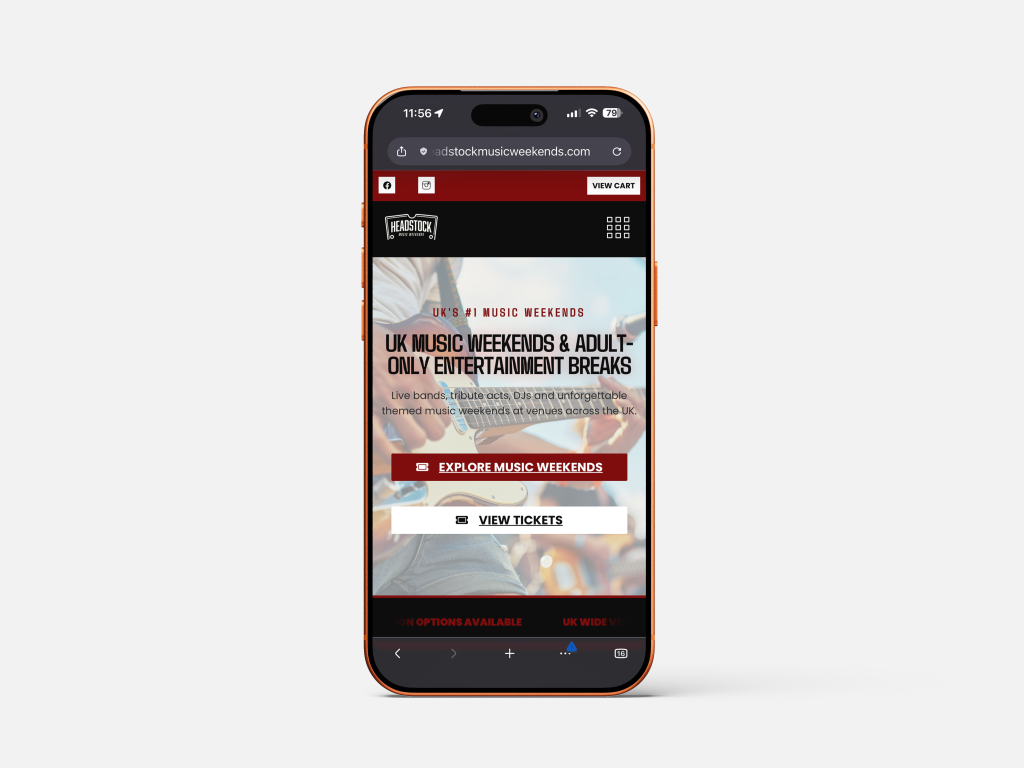
Headstock Music Weekends
Website, SEO & Ticket Sales Growth
See how a long-term digital strategy helped strengthen organic visibility, customer acquisition and event ticket sales.
Go Your Own Way
Creative & Digital Support for Touring Entertainment
Supporting the digital presentation and wider marketing of an established UK touring production.

Sweet & Sour
Tour Artwork & Entertainment Creative
Developing promotional graphics designed around the identity and audience of a touring tribute production.
Frequently Asked Questions About Theatre Tour Marketing
What is theatre tour marketing?
Theatre tour marketing is the process of promoting a touring production across multiple venues and locations. It can combine paid advertising, social media, venue marketing, email, websites, SEO, PR, content and ticket-sales analysis to build awareness and drive audiences towards individual performances.
What is venue-by-venue marketing?
Venue-by-venue marketing treats each tour date as an individual local market while maintaining the wider branding and positioning of the production. Campaign activity can be adjusted according to location, venue capacity, ticket sales, audience behaviour and marketing performance.
How far in advance should you market a theatre show?
There is no single timeline suitable for every production, but marketing should generally begin well before the final weeks of a performance. Larger venues and productions with lower existing awareness may require considerably longer campaigns.
How do you increase ticket sales for a theatre tour?
Increasing ticket sales can involve improving audience targeting, creative, venue collaboration, websites, retargeting, email marketing, organic content and local advertising. The first step should be understanding why a particular date is underperforming rather than automatically increasing advertising spend.
Should every theatre receive the same advertising budget?
Not necessarily. Capacity, current sales, historic performance, audience size, venue support and advertising performance can all determine where budget is most valuable.
Can Meta Ads help sell theatre tickets?
Facebook and Instagram advertising can help touring productions reach relevant audiences around specific venues, build awareness and retarget people who have previously interacted with the production.
Does SEO help theatre productions sell tickets?
SEO can help audiences discover productions when searching for shows, artists, venues, locations and things to do. It can be particularly valuable for established touring productions that repeatedly visit UK towns and cities.
Can Encore Essentials manage marketing across an entire UK theatre tour?
Yes. Encore Essentials can support touring productions across strategy, websites, SEO and GEO, Meta advertising, social media, content, graphic design, email marketing and venue-by-venue campaign management.
Built by touring professionals. Made for live entertainment.
Looking for marketing support from inside the entertainment industry?
Founded in 2014, Encore Essentials helps artists, touring productions and internationally recognised shows sell tickets, build audiences and create genuine excitement around their productions.
We combine first-hand touring experience with creative, digital and data-led marketing to develop campaigns that don’t just promote the show — they work alongside it.
Websites • Meta Ads • SEO & GEO • Social Media • Content • Email • Graphic Design • Tour Marketing